
What we mean by toolmaking
Tools as part of the overall process.
For us, toolmaking is not an isolated step, but a central part of the entire manufacturing process. From part design to production readiness, the tool is consistently engineered for function, process reliability and service life.
From component to tool: Structured and coordinated.
Before a mould is produced, the component, the requirements and the subsequent production of the plastic part must be clearly defined. Only if the geometry, material, production volumes and series production conditions are taken into account at an early stage can a mould be designed that delivers consistently stable and reproducible results in production.
Our approach is designed to minimise risks and ensure that decisions are properly documented. Each step builds on the previous one and is carefully documented – so that a component is transformed into a tool that is suitable for production and functions reliably.
Designed for the component – not the other way around.
Tools for different requirements
Tools are always designed according to the specific application. Factors such as production volume, material, geometry and tolerances determine the tool design, number of cavities (number of parts produced simultaneously) and overall configuration.
Are you looking for a tool that really suits your component?
Optimization & adjustments
Continuous tool optimization.
Even after initial sampling, tools are adjusted and optimized if necessary. The goal is to stabilize processes, reduce scrap and ensure long-term production capability.
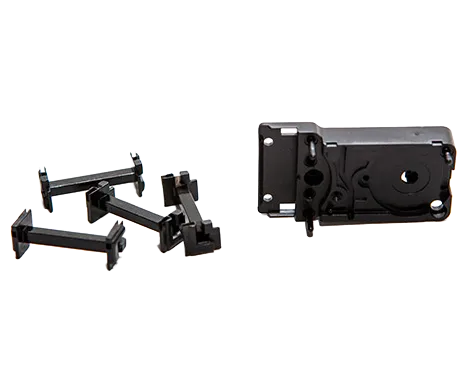
Would you like to relocate a tool?
Tool relocation – stable from the very first shot.
When existing tools are moved to a new site, a structured handover is crucial. We support tool relocations with the aim of returning to a stable production process as quickly as possible.
To this end, we carry out technical inspections of the tool, coordinate interfaces and conduct sampling – all of which is documented and traceable.
Our aim: to minimise disruption as much as possible – to ensure a smooth restart at the new production site.
Frequently asked questions
FAQ about toolmaking
Through coordinated tool design, structured sampling and close integration with manufacturing and quality.
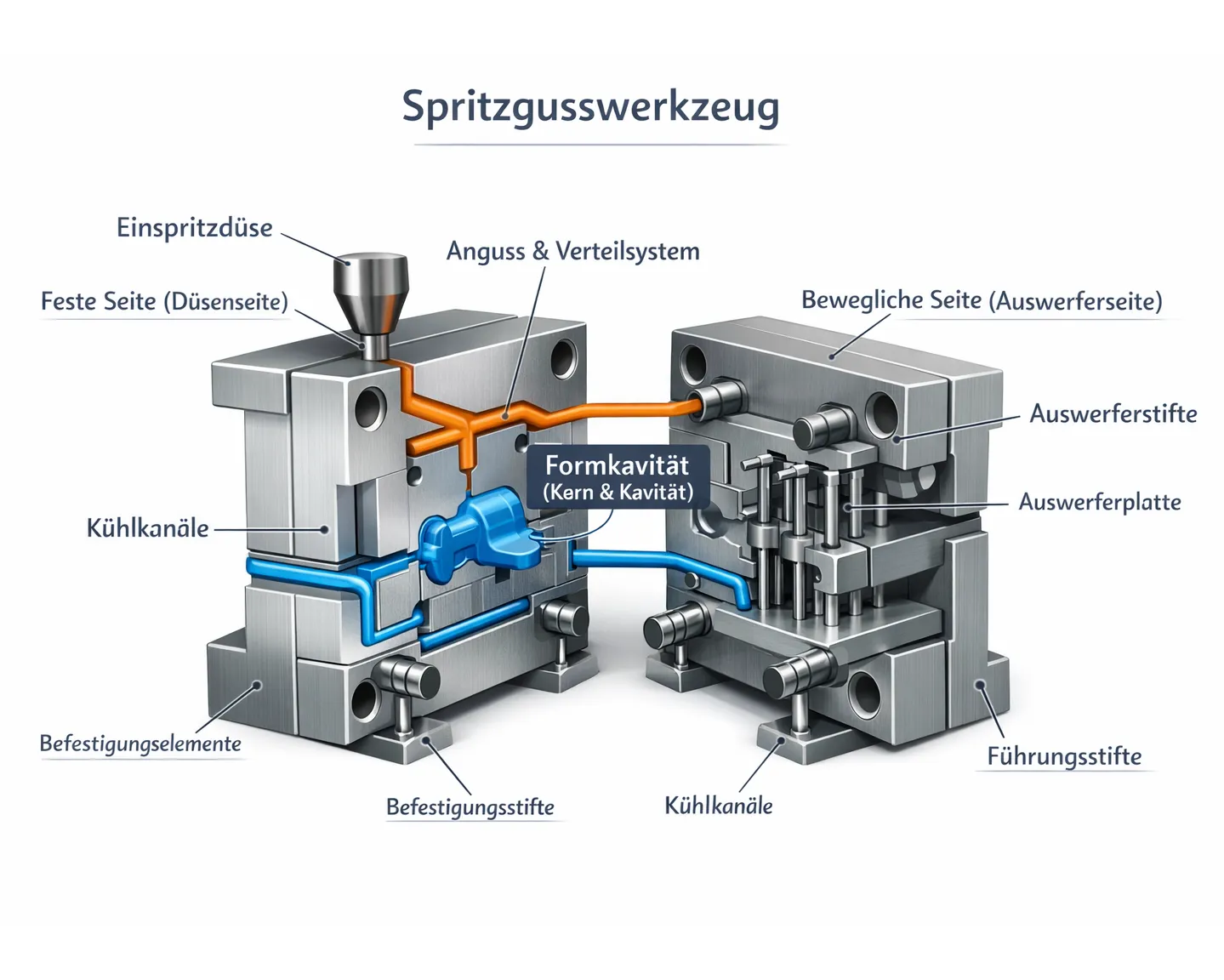
An injection moulding tool is precision-engineered and consists of several interlocking components which, together, determine the shape of the resulting plastic part and enable the production process.
In general, an injection moulding tool consists of two halves: the fixed half (nozzle side) and the moving half (ejector side). Between these two halves lies the mould cavity – the hollow space that replicates the exact geometry of the component. This usually comprises a core and a cavity, which together form the inner and outer contours.
The molten plastic is fed from the injection moulding machine into the cavity via the sprue and runner system. To ensure that the component can be removed from the mould once it has cooled, the mould is equipped with an ejection system that ejects the finished part in a controlled manner.
Another key component is the cooling system. Integrated cooling channels regulate the mould temperature, which is crucial for component quality, dimensional accuracy and cycle time. The mould is complemented by guides, seals and fasteners, which ensure precise alignment and safe operation.
The exact design of an injection mould depends heavily on the component, the plastic used and the planned production volume – the aim is always to achieve stable, repeatable and cost-effective production.
Would you like to gain a better understanding of the interrelationships in toolmaking?
On our knowledge page, you will find a concise overview of the design of injection moulds, the different types of moulds, the development process, and the importance of moulds for quality, process stability and cost-effectiveness in plastic injection moulding.

Call us
Send us an email